
Sustainability is rapidly becoming one of the defining forces in modern yacht engineering. As environmental regulations evolve and owner expectations shift, leading shipyards are increasingly investing in hybrid propulsion systems, alternative fuels and advanced energy-management technologies.
According to Sanlorenzo’s official “Road to 2030” initiative, the future of yacht construction will focus heavily on reducing emissions while maintaining luxury, comfort and long-range cruising capabilities (Sanlorenzo, 2026).
The Rise of Hybrid Propulsion
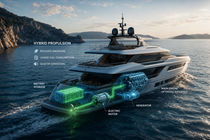
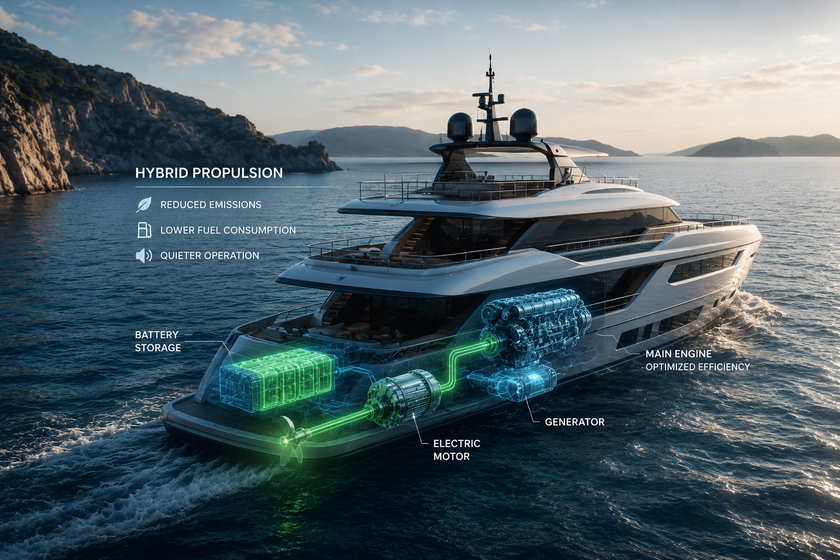
Hybrid propulsion combines conventional diesel engines with electric motors and battery storage systems. The objective is to reduce fuel consumption, lower emissions and improve onboard efficiency without compromising performance.
Industry experts note that hybrid systems allow yachts to operate partially or fully on electric power during low-speed cruising, anchoring or marina manoeuvres. This significantly reduces onboard noise, vibration and local emissions.
The Dubai International Boat Show describes hybrid technology as one of the key innovations shaping the future of sustainable yachting, stating that hybrid propulsion can “reduce fuel consumption and improve onboard efficiency” (Dubai International Boat Show, 2026).
Modern energy-management systems also optimize how energy is generated, stored and redistributed onboard. According to industry analyses, hybrid technologies may reduce fuel consumption by up to 30% in certain operational scenarios (Boat Show Dubai, 2026).
Sanlorenzo and Sustainable Superyachts
Italian shipyard Sanlorenzo is widely regarded as one of the pioneers in sustainable superyacht engineering.
Through its “Road to 2030” strategy, the company is investing heavily in hybrid propulsion systems, sustainable materials and methanol-based fuel cell technology (Sanlorenzo, 2026).
One of the most important recent milestones was the launch of the 50Steel “Almax”, described by Sanlorenzo as the world’s first superyacht equipped with a Green Methanol Reformer Fuel Cell system developed together with Siemens Energy.
Sanlorenzo explains that this system allows hotel loads onboard to operate with near-zero emissions while the yacht is at anchor (Sanlorenzo Sustainability Report, 2026).
The company is also developing future-oriented concepts such as the SHE project and upcoming methanol-powered superyachts designed to significantly reduce the environmental footprint of luxury yachting.
According to Sanlorenzo Yachts UK, the shipyard’s long-term objective is to create “a new generation of environmentally conscious superyachts” while preserving the luxury experience expected by owners (Sanlorenzo Yachts UK, 2026).
Feadship and Hydrogen Innovation
Dutch superyacht builder Feadship is also positioning itself at the forefront of sustainable yacht engineering.
The company introduced “Project 821”, later named Obsidian, one of the world’s first hydrogen fuel-cell superyachts. Feadship describes hydrogen technology as a “major step toward zero-emission superyachting” (Feadship, 2026).
Unlike traditional diesel-powered yachts, hydrogen fuel cells generate electricity through a chemical process that produces water as the primary by-product. While the technology is still in its early stages, many industry analysts consider hydrogen one of the most promising long-term solutions for reducing maritime emissions.
According to Boat International, Feadship’s hydrogen initiatives demonstrate how sustainability is beginning to reshape even the ultra-luxury segment of the yacht industry (Boat International, 2026).
Ferretti Group and Hybrid Expansion
The Ferretti Group has also accelerated its sustainability investments across several brands, including Pershing, Riva and Custom Line.
Ferretti states that hybrid propulsion and energy-efficiency improvements are becoming increasingly important as owners seek more environmentally responsible cruising solutions (Ferretti Group Sustainability Report, 2026).
The company is currently integrating:
- hybrid propulsion systems
- lightweight materials
- advanced hull optimization
- smart energy-management systems
across multiple yacht platforms.
Industry observers note that Ferretti’s strategy focuses on balancing performance-oriented yacht design with lower environmental impact.
Sunreef Yachts and Solar Catamarans
Polish shipyard Sunreef Yachts has taken a different approach by focusing heavily on solar-electric catamarans.
Its “Sunreef Eco” series integrates solar panels directly into the hull sides, hardtops and superstructures of the yacht.
According to Sunreef Yachts, the objective is to create “fully autonomous luxury yachts” capable of significantly reducing dependence on fossil fuels (Sunreef Yachts, 2026).
The company’s electric catamarans combine:
- solar energy
- electric propulsion
- battery storage
- lightweight composite construction
to maximize energy efficiency and silent cruising.
Sunreef’s approach illustrates how sustainability trends are not limited to large superyachts but are increasingly influencing the broader luxury-yachting market.
Beyond Propulsion: A New Engineering Philosophy
Sustainability in yacht engineering now extends far beyond propulsion systems alone.
Modern shipyards increasingly integrate:
- lightweight construction materials
- optimized hull geometries
- solar-assisted systems
- energy recovery technologies
- sustainable interior materials
- intelligent onboard energy-management software.
The industry is also actively exploring hydrogen propulsion and alternative fuels such as green methanol.
Financial Times recently described hydrogen and fuel-cell technologies as potential “eco future solutions” for the superyacht industry as environmental regulations continue to tighten (Financial Times, 2026).
Several current projects already demonstrate how future yachts may significantly reduce emissions while still delivering the comfort, privacy and craftsmanship associated with luxury yachting.
Sustainability as the New Luxury Standard
For many modern yacht owners, sustainability is no longer considered optional. Environmental responsibility is increasingly viewed as part of contemporary luxury itself.
Buyers are now evaluating yachts not only by design, craftsmanship and performance, but also by energy efficiency and long-term environmental impact.
Industry analysts expect hybrid propulsion systems and alternative-fuel technologies to become increasingly standard across multiple yacht categories over the coming decade.
What was once considered experimental engineering is gradually becoming the new benchmark in contemporary yacht construction.
Sources
Boat International. (2026). Sustainable Superyacht Technologies. Available at: https://www.boatinternational.com/ (Accessed: 12 May 2026).
Dubai International Boat Show. (2026). Sustainable Yachting: The Benefits of a Hybrid System. Available at: https://www.boatshowdubai.com/ (Accessed: 12 May 2026).
Feadship. (2026). Hydrogen and Sustainable Innovation Projects. Available at: https://www.feadship.nl/ (Accessed: 12 May 2026).
Ferretti Group. (2026). Sustainability Report. Available at: https://www.ferrettigroup.com/ (Accessed: 12 May 2026).
Financial Times. (2026). Is Hydrogen the Eco Future of Superyachting?. Available at: https://www.ft.com/ (Accessed: 12 May 2026).
Sanlorenzo. (2026). Road to 2030 – Sustainability Strategy. Available at: https://www.sanlorenzoyacht.com/en/sustainability/product (Accessed: 12 May 2026).
Sanlorenzo Yachts UK. (2026). Sustainability and Innovation in Modern Luxury Yachting. Available at: https://sanlorenzoyachts.co.uk/sustainability-and-innovation-in-modern-luxury-yachting/ (Accessed: 12 May 2026).
Sunreef Yachts. (2026). Sunreef Eco. Available at: https://sunreef-yachts.com/ (Accessed: 12 May 2026).