
Technological Transformation, Market Development and the Future of Smart Yachting
Artificial intelligence is beginning to reshape several areas of the maritime industry, including yacht navigation, onboard automation, technical monitoring and shipyard development processes. While fully autonomous yachts are still far from becoming an operational standard in the luxury sector, AI-supported systems are already influencing how modern yachts are designed, operated and maintained.
In my view, the discussion around artificial intelligence in yachting should not focus exclusively on replacing captains or crew. The more realistic and commercially relevant development is the gradual integration of intelligent support systems capable of improving operational efficiency, safety, predictive maintenance and onboard management.
Autonomous Navigation and AI-Assisted Operations
The concept of autonomous vessels is already well established within the commercial maritime industry. The International Maritime Organization (IMO) has been actively working on regulatory frameworks for Maritime Autonomous Surface Ships (MASS), including discussions regarding future operational standards, safety protocols and legal frameworks (International Maritime Organization, 2025).
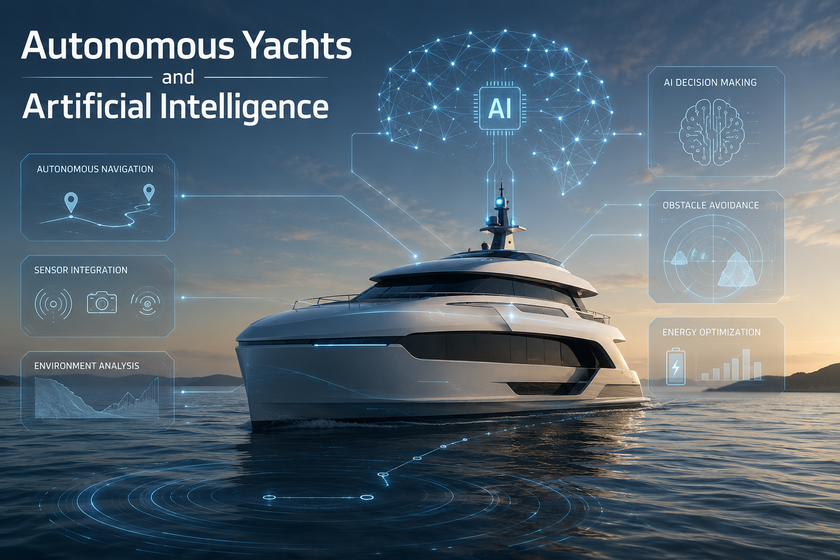
At present, the yacht industry is primarily moving toward assisted autonomy rather than fully autonomous navigation. Modern systems increasingly support captains through:
- AI-assisted route optimization,
- weather analysis,
- collision avoidance technologies,
- sensor fusion systems,
- energy management,
- and automated maneuvering assistance.
According to research published in Ocean Engineering, artificial intelligence has the potential to significantly improve maritime operational safety, reduce navigational risk and support decision-making processes through real-time data analysis (Zhang et al., 2025).
Despite rapid technological progress, the complexity of the superyacht environment still requires experienced human oversight. Unlike commercial shipping, luxury yachting involves highly individualized operations, guest experience management and complex marina environments where human judgment remains essential.
The Rise of the Smart Yacht
Modern yachts are gradually evolving into highly connected digital ecosystems. Traditionally, navigation systems, onboard monitoring, security, entertainment and technical operations often functioned through isolated interfaces. Artificial intelligence now enables greater integration between these systems.
One recent example comes from Next Yacht Group, which introduced a prototype AI-integrated onboard assistant designed specifically for luxury yachts. The company stated that the system focuses on local onboard processing rather than relying entirely on cloud-based infrastructure (Next Yacht Group, 2025).
According to the company presentation, the system is designed to integrate:
- technical monitoring,
- energy management,
- alarm systems,
- maintenance scheduling,
- environmental controls,
- and onboard automation.
Although such systems are still in an early stage of commercial adoption, they demonstrate the direction in which smart yacht management is evolving.
Predictive Maintenance and Digital Twins
One of the most practical and commercially valuable applications of artificial intelligence in yachting is predictive maintenance.
Rather than relying exclusively on fixed maintenance intervals or reactive repairs, AI-supported systems can continuously analyze operational data and detect irregularities before technical failures occur.
This development is closely connected to digital twin technology. A digital twin is a real-time digital representation of a vessel that receives continuous operational data from onboard systems.
According to Mewburn Ellis (2024), digital twin systems can support:
- engine performance analysis,
- fuel optimization,
- emissions monitoring,
- maintenance forecasting,
- and regulatory compliance.
In practical terms, this may help yacht operators reduce downtime, optimize servicing schedules and improve long-term operational reliability.
Marine AI also identifies predictive maintenance and smart monitoring as key growth areas within future leisure vessel development (Marine AI, 2025).
Artificial Intelligence in Yacht Design and Shipbuilding
Artificial intelligence is not only influencing onboard operations but also transforming yacht construction and design processes.
Modern shipyards increasingly utilize:
- AI-assisted engineering,
- digital production systems,
- mixed reality environments,
- real-time collaborative design platforms,
- and advanced simulation technologies.
According to SSI Corporate (2025), digital shipbuilding technologies can reduce engineering conflicts, improve production efficiency and support more accurate project coordination throughout the construction process.
This is particularly important within the superyacht sector, where projects often involve highly customized engineering solutions and coordination between multiple stakeholders, including:
- naval architects,
- interior designers,
- classification societies,
- technical consultants,
- suppliers,
- owners’ representatives,
- and operational crew.
As projects become more technologically advanced, digital integration is likely to become a significant competitive advantage for shipyards.
Market Development and Industry Growth
The market for autonomous maritime systems and AI-supported vessel technologies is currently experiencing strong investment activity and technological growth. However, available market forecasts vary considerably depending on methodology and sector definition.
Several market studies project substantial long-term growth within autonomous shipping and maritime AI technologies.
Fortune Business Insights estimates that the global autonomous ship market could grow from approximately USD 6.58 billion in 2025 to USD 13.85 billion by 2034 (Fortune Business Insights, 2025a).
A separate analysis by the same research company projects the autonomous boat market to grow from USD 627.9 million in 2026 to approximately USD 1.18 billion by 2034 (Fortune Business Insights, 2025b).
Meanwhile, Allied Market Research forecasts even stronger growth across the broader autonomous shipping sector, projecting a market size of USD 217.6 billion by 2033 (Allied Market Research, 2025).
These forecasts should be interpreted carefully, as definitions of “autonomous vessels” differ significantly between reports. Some studies include commercial shipping, naval applications and industrial automation systems, while others focus more narrowly on civilian navigation technologies.
Nevertheless, the overall market direction is clear: the maritime industry is steadily moving toward higher levels of automation, digital integration and AI-supported operations.
Industry Challenges and Limitations
Despite technological progress, several limitations continue to slow the development of fully autonomous yachts.
The most significant challenges include:
- international maritime regulation,
- cybersecurity risks,
- liability and insurance questions,
- operational redundancy requirements,
- integration with existing crew structures,
- and owner confidence in autonomous systems.
Within luxury yachting, trust and personal experience remain central components of the industry. Owners continue to value experienced captains, personalized service and human decision-making capabilities.
For this reason, the near future of yachting will most likely focus on AI-assisted operations rather than completely unmanned vessels.
Conclusion
Artificial intelligence is beginning to influence the yachting industry in meaningful and measurable ways. The most relevant developments are currently not fully autonomous superyachts, but intelligent support systems capable of improving operational efficiency, technical management and onboard safety.
The future yacht will likely combine:
- AI-supported navigation,
- predictive maintenance systems,
- smart onboard automation,
- digital shipyard integration,
- and advanced operational analytics.
The role of captains and crew will remain essential. However, artificial intelligence will increasingly function as a sophisticated support system capable of assisting operational decisions and improving the overall yachting experience.
For shipyards, brokers, yacht managers and owners, understanding these developments is becoming increasingly important as the industry moves toward a more connected and technology-driven future.
References
Allied Market Research. (2025). Autonomous Ships Market to Reach $217.6 Billion by 2033. Retrieved from: https://www.globenewswire.com/news-release/2025/01/28/3016528/0/en/autonomous-ships-market-to-reach-217-6-billion-globally-by-2033-at-9-5-cagr-allied-market-research.html
Fortune Business Insights. (2025a). Autonomous Ship Market Size, Share & Industry Analysis. Retrieved from: https://www.fortunebusinessinsights.com/industry-reports/autonomous-ship-market-101797
Fortune Business Insights. (2025b). Autonomous Boats Market Size, Share & Growth Analysis. Retrieved from: https://www.fortunebusinessinsights.com/autonomous-boats-market-113706
International Maritime Organization. (2025). Symposium on Maritime Autonomous Surface Ships (MASS). Retrieved from: https://www.imo.org/en/About/Events/Pages/MASS-Symposium-2025.aspx
Marine AI. (2025). Leisure Vessels and Smart Maritime Systems. Retrieved from: https://marineai.co.uk/leisure-vessels/
Mewburn Ellis. (2024). Digital Twin Technology in Ship Design and Maintenance. Retrieved from: https://www.mewburn.com/forward/digital-twin-technology-in-ship-design-and-maintenance-optimizing-vessel-performance-predictive-maintenance-and-regulatory-compliance
Next Yacht Group. (2025). Next AI Integrated System for Luxury Yachts. Retrieved from: https://www.nextyachtgroup.com/news-and-boat-show/next-yacht-group-presents-next-ai-integrated-system-the-first-local-first-ai-assistant-designed-for-luxury-yachts/
SSI Corporate. (2025). AI in Shipbuilding and Digital Transformation. Retrieved from: https://www.ssi-corporate.com/blog-lighthouse/ai-in-shipbuilding/
Zhang, Y., et al. (2025). Advancing Artificial Intelligence in Ocean and Maritime Engineering. Ocean Engineering. Retrieved from: https://www.sciencedirect.com/science/article/pii/S0029801825017615